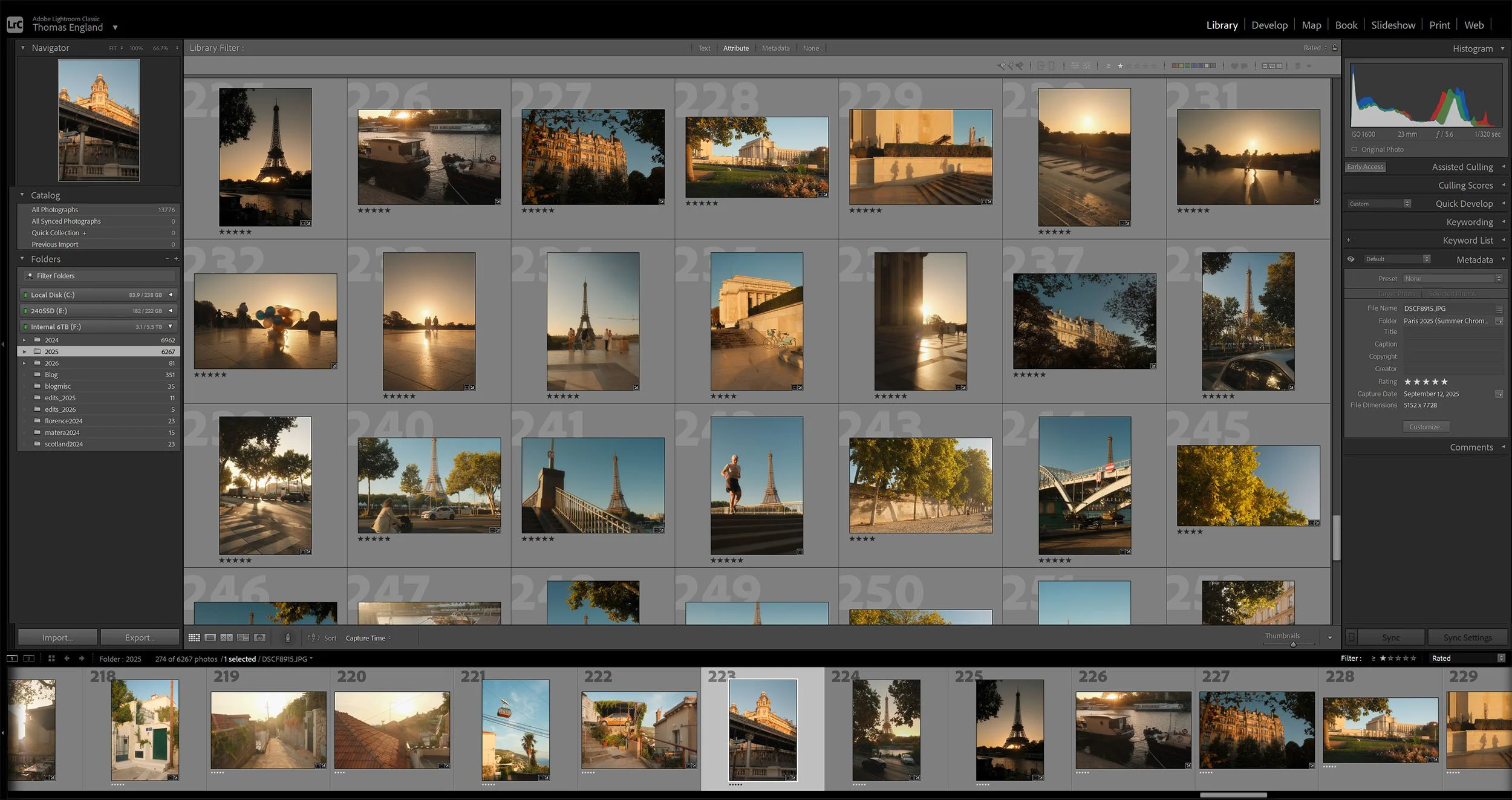
Every photographer faces the same moment of truth: the review process. When you’re staring down hundreds of shots from your travels, how do you know what stays and what goes? What’s the first step in editing, and which images deserve your full attention? For me, deciding what to delete, rate, or save goes beyond that initial scan. It’s an evolving part of the creative journey. Some shots I once ignored can spark fresh inspiration, while others I once admired have lost their magic. Learning to evaluate my work honestly has become one of the most valuable skills in my growth as a photographer. Revisiting old photos years later often reveals unseen potential; images I might have deleted too quickly now find new life in my portfolio.
Each import begins with both excitement and cautious optimism. I ask myself: are these photos as strong as I hoped they’d be? Which ones deserve a five-star rating for immediate editing, a four-star for “maybes,” or a place in the archive to revisit with fresh eyes later? That initial review, balancing instinct and curiosity, sets the tone for everything that follows in my editing process.
What Gets Deleted
From the thumbnail view in Lightroom, it’s often easy to spot which images need to go. While I do review nearly every photo in full, some are clearly unusable right from that small preview. Those are the first ones I delete. They free up hard drive space and eliminate unnecessary clutter, so I never have to sift through them again.
The first to go are the obvious mistakes: the accidental shot of my feet, a blurry corner of a wall, or a misfire while adjusting settings. I don’t like deleting photos directly on my camera, so once everything’s imported, I can remove these in one initial sweep.
Next to go are the test shots, the ones that didn’t land. They’re often severely underexposed, blown out, or otherwise off the mark. These usually sit right beside the usable ones, helping me see what I was testing and where I eventually found the sweet spot for exposure.
Finally, I deal with the blurry images. These require a closer look than the thumbnail provides, which is why this is the last step of the delete process. If the softness or missed focus wasn’t intentional, I’ll delete them. Blur can be beautiful when used creatively, adding motion or emotion to a scene, but when it’s accidental, it’s deleted.
What and How I Rate My Images
This is always the most exciting part of the process for me: the review and tagging stage. It’s where I begin selecting the images that stand out most, the ones I’ll focus on first. Out of a few hundred photos from a trip, I typically end up with around 30 to 40 that make the initial rating, though that number can vary. These are the shots that truly resonate with me, the ones I know have the potential to become lasting pieces in my portfolio.
When I start rating, I use a quick and intuitive test: Does the image strike me right away? Does it convey a story or emotion I connect with? Is it aligned with my intent? If the answer is yes, it gets a 5-star rating in Lightroom. I spend only four to five seconds on each image before moving on. This first round is all about instinct; finding the most powerful, story-driven photos. Sometimes, I’ll lower a rating after a second look if a shot doesn’t hold up as strongly on review.
Images that show promise but need further consideration receive a 4-star rating. They’re good, absolutely, but I’m not yet sure how they fit with the stronger ones. 4-star images usually stand well on their own, but do they work as a collective? After editing the 5-star selections, I revisit these to see if they complement or distract from the overall narrative. I may need to step away from the computer and return later with fresh eyes to reassess whether my initial excitement was justified.
From there, I filter my Lightroom catalogue to show only starred images. This helps me see how the chosen photos work together, what feels cohesive and what feels disjointed. I ask myself which images still hold their strength and which ones may no longer belong. This visual comparison reveals how each photo supports the story I’m trying to tell. In the end, 4 and 5-star ratings are the only ones I use; everything else stays unstarred until it earns its place or quietly fades into the background.
What continues to surprise me is how often my expectations flip. The photos I thought would be the clear standouts often turn out to be above average, while the simple, unassuming moments I barely noticed at the time become the most impactful. It happens more often than I’d like to admit, yet it’s something I’ve learned to embrace. Those quiet shots often carry the strongest stories.
Which Images Are Archived
After I’ve culled and deleted the obvious mistakes and test shots, everything else stays in the archive. I usually keep my work in Lightroom for about two years, and while those files don’t take up any more space there than they do on my hard drive, I prefer to clear them out for the sake of organization. After that, I keep them archived on my hard drive and in cloud backup. I also like revisiting past travels from time to time, especially when I’m looking for fresh images for blog posts or other projects. Every few years, I may even reimport an entire trip. After being away from the images for a long time, I often find that seeing them again with fresh eyes makes the experience even more rewarding.
Conclusion
In the end, my editing process can be quite basic compared to others. Each folder is named and imported into a folder by year. It’s a process that helps me learn to see my own work in the moment and, honestly, over time. Deleting obvious mistakes, rating the strongest images, and archiving the rest, helps me separate the strongest moments now from photographs that may have something to say later, and that’s why I trust this basic process.