Behind the Scenes: Writing A Beginner’s Guide to Automotive Light Painting
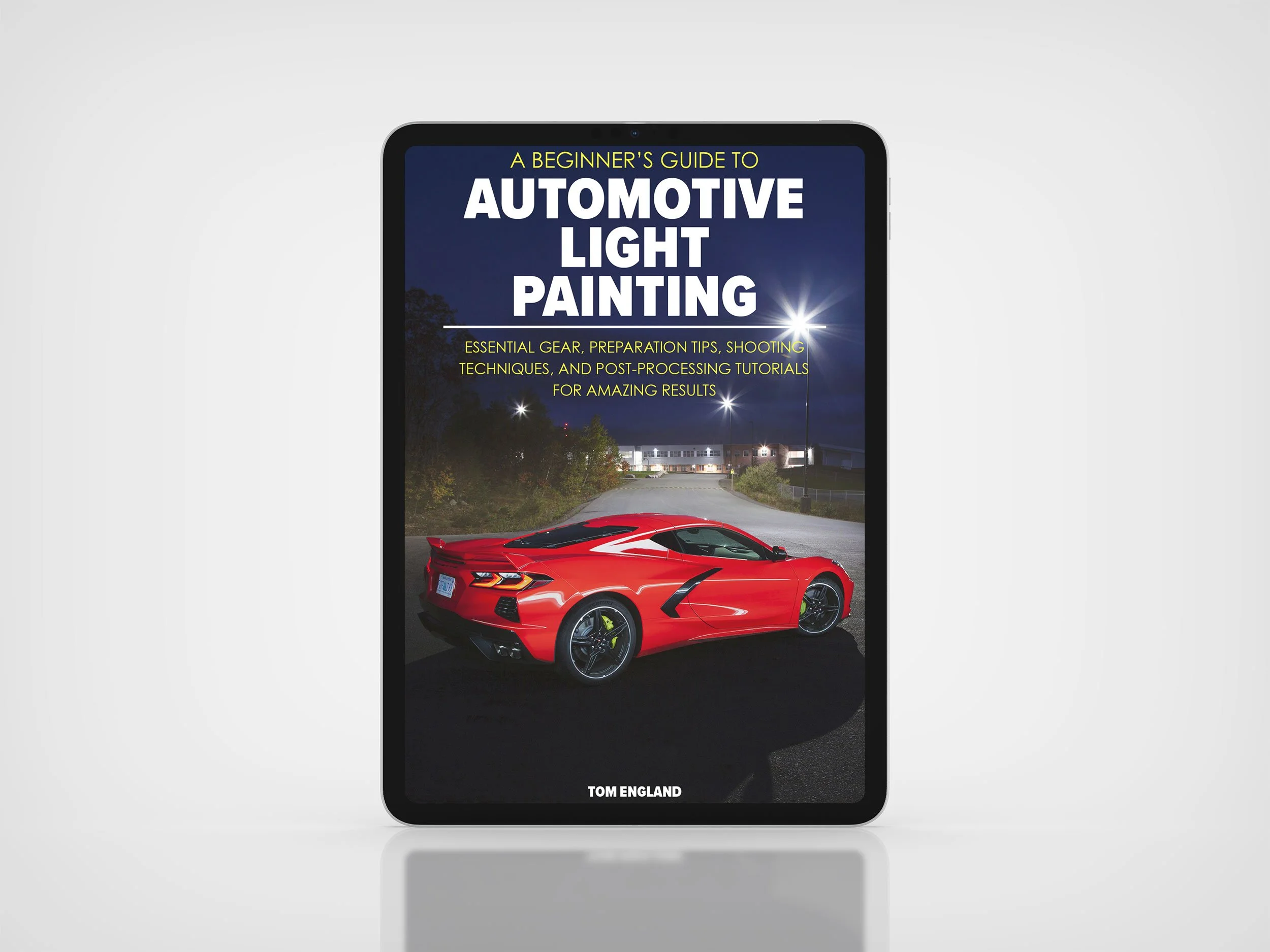
It’s been 8 months since I self-published my second book, and the first on photography technique and process. I was thinking about how long I have been doing it. I don’t get a ton of questions about my photography, but when I do, they usually revolve around light painting. It’s a technique that, for the unaware, looks magical.
Where the Book Actually Started
First, I started taking notes about the topics I would cover if I wanted to do this. Nothing formal at first, just topics I’d already covered on the blog and some I had not up to that point. At first, I thought it could be a good framework for future blog posts, but as the notes evolved, I realized there was more to it. Not just periodic blog posts spread out over time, but one central location for automotive light painting; the beginning stages of attempting this on your own. Those notes eventually became a 139-page, eight-chapter book.
I’d written about light painting since I started this blog over four years ago. What I hadn’t done was put it all in one place in a way that would actually make sense to someone starting from zero. So before I wrote a single new sentence, I went back through my entire blog archive, everything I’d published on light painting over the years, to see what I’d actually said about it already. Some of that content was repurposed for the book.
I started with general notes and bullet points, topics I wanted to cover. With my notes coming together, I started to separate them into categories. I moved everything into Google Docs, one document per chapter. Keeping each chapter as its own separate doc made it much easier to work on them out of order, adding as these came to mind. Some days I’d make progress on the gear chapter; other weeks I’d barely touch it and instead push forward on post-processing. It was all about where my motivation was at that time. That progression would evolve into the book’s chapters: fundamentals, gear, scene prep, shooting technique, managing tricky subjects, composition and storytelling, and more.
Designing for Clarity
The book is explicitly a beginner’s guide, aimed at photographers who are comfortable with a camera but new to light painting specifically, and every chapter had to have its place towards that goal. Ten years in, some of my light painting steps feel like habit. I’m not thinking about some of the finer nuances because so much of the adjustment and adaptation in the moment is reactive. While working on the chapters, I found myself going back to add steps and thoughts that weren’t obvious to include at first.
I also went through a fair number of early attempts at illustrating some of the concepts: sketches showing light pass angles and diagrams mapping out movement paths around a car. They never made it into the final book. On paper, they seemed like they’d be useful for the points structured in the book and much easier to follow than text alone. And I’ll tell you, they did not work. They looked terrible and, as a result, were confusing to follow. After a first pass on the draft, they were quickly abandoned.
The overall design evolved as well. I made the deliberate choice to hold back on styling and scaled back numerous times during the review stage. I am not a designer, and I could see where I was pushing my limited design skills a bit too far. It was looking a little design-for-design’s-sake, and I kept cutting things that didn’t add anything. They only distracted from the content.
The design stays simple on purpose. I’d rather the book read like a clear set of instructions than anything. The photography and the explanations are the point.
One thing I was adamant about early on was that this couldn’t be a theoretical guide. To me, that wouldn’t be very useful. Everything in the book needed to trace back to something I’d actually done, not a big picture version of how light painting is supposed to work. It had to include what I know firsthand, techniques I’ve tried and tested over numerous shoots. If I couldn’t refer to a real shoot where a technique had been used, it didn’t belong in this book. That’s also why the post-processing sections of the book are on how I do it. Others may have variations in their approach, but the foundation of it is how I have approached it for my final photos. There is no single way to light paint.
The eBook Decision
From the beginning, the question was: in what formats would this be published? When I started, I wasn’t sure whether it would be only an eBook or if a print version would follow. It’s been 8 months, and I still haven’t ordered any print copies; however, the file is ready to go if I decide. Print books require time and shipping. So, weighing the cost of a book with shipping, it was starting to creep up. With an eBook, I could sell immediately and, if needed, make revisions. Can’t do that with a print version without an entirely new run.
The eBook made sense as the first release: an $18 CAD PDF and ePub package that could be released on my own timeline without asking for too much of a financial commitment from buyers.
Why This Mattered to Me
I had this idea for a while, but I was reluctant to start because I wasn’t sure where it was going. Would it become anything at all? But as the first few chapters came together, my own understanding of light painting did too, as I needed to articulate it. I’ve always thought of light painting as one of the more accessible entry points into some unique automotive photography. Still, it can be complicated until you understand its foundation. After my time with the craft, I felt like I was finally in a position to share my experience with someone else in a structured, complete way.
A Beginner’s Guide to Automotive Light Painting is available now as an eBook through my shop.